


The Entire Story of FY27 Told on the First Day
The beginning of a new financial year is generally an optimistic wary time. New money, new period, and a blank calendar. However, April 1, 2026 was not typical of the Indian equity investor.
The BSE Sensex jumped by a point of more than 1,899 in the initial trading to hit 73,847 and the Nifty 50 rose by almost 573 points to hit 22,903 not because the underlying stress was actually solved but because the market was taking a breather. The signals of a possible readiness to de-escalate the current conflict with the United States by the Iranian diplomacy were sufficient to trigger a strong short-covering movement in all the world markets.
The move was also accompanied by Asian counterparts with South Korea Kospi surging almost 7 percent and Japan Nikkei increasing more than 4 percent, which is indicative of the extent to which risk appetite had been hampered in the preceding days.
However, this is what investors should realize: the bounce occurred on an extremely battered background. And to figure out where markets are headed, you must know the complete history of what has just happened – and why.
Badness of FY26 Ending?
To see the future, begin at the end of fiscal year 2026. Indian markets had recorded the lowest annual performance since FY20. The Nifty ended the fiscal year by falling by about 5 percent and Sensex fell by around 7 percent. The Nifty plunged more than 11 percent in March alone the sharpest monthly decline in six years since the COVID crash in March 2020.
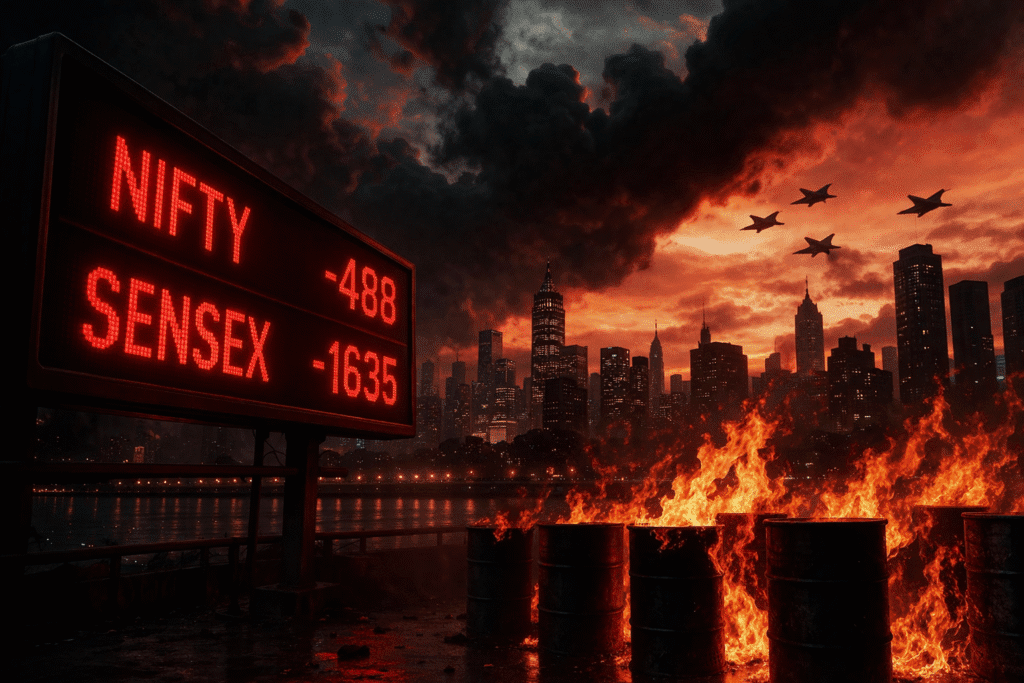
On March 28, the last day of trading in the FY26, the Nifty plummeted 488 (2.14) to close at 22,331, and Sensex was down 1,636 to end at 71,947. Focus on selling pressure was focused to financial stocks, Bajaj Finance, Shriram Finance, and State Bank of India were some of the worst affected.
The culprits? There were three mutually feeded forces that interacted over the month.
Also Read : Crude Oil Prices Surge After Israel-Iran Tensions: Will Prices Cross $100?
Understanding the Three Pressure Points.
1.The US-Iran Dispute and the Market Mechanics.
The geopolitical shock that has been central to this whole wave of volatility is the military conflict between the United States and Iran that is still taking place. News of massive US military mobilization in the area, coupled with the entry of Houthi forces into the conflict and attacks on Israeli targets, transformed an already tense standoff into the active one.
In the case of Indian markets, the battle is of direct and well-understood route, which is crude oil. The price of the Brent crude shot up to the 115-116 per barrel threshold at the height of the tensions – which is directly threatening the macroeconomic stability of India. India is an importer of approximately 85 per cent of its crude oil needs and therefore any significant increase in the global oil prices is almost instantly reflected as:
- Expanding current account deficit through an increase in import bill.
- The pressure on depreciation of the rupee that raises the issue of imports further.
- Increased inflation, as the cost of logistics and fuel is passed on to the consumer.
- Reduced fiscal headroom in the government, which in turn is pressured on subsidies.
It is not hypothetical risk, but it is an established method of transmission that investors have observed in action many times, most recently with the conflict in Russia-Ukraine in 2022.
2. FII Outflows: The Institutional Exodus.
In the month of March 2026, Foreign Institutional Investors (FIIs) were the active sellers. The net FII outflows in the month were more than 60, 000 crore, which is comparable to the 70000 crore outflow in a single month that occurred in February 2022 with the invasion of Ukraine by Russia.
On top of the spot selling, FII net short positions in index future increased to almost 250,000 contracts, which is a sign of extensive institutional pessimism and also preconditions a violent short-covering upsurge in case of a change of mind. That is exactly what April 1 st showed.
Where the FIIs are so short, as well as so much likely to be on the bearish side, any plausible de-escalation signal can lead to a mechanical squeeze. The market does not have to be fixed to experience a bounce but it only requires fewer individuals to be panicking simultaneously.
3. RBI Regulatory Measures Introduction of Short-term Friction.
Together with the geopolitical ruckus, the Reserve Bank of India also came up with new measures that restricted the onshore forex positions of banks to $100 million per bank. Although the move was to cushion the falling rupee against speculative attacks, the market response was the short-term selling spurt in banking giants as the institutional investors tried to reprisal their operations.
This introduces an element of domestic regulatory risk into an already high global risk environment, and is the reason that banking stocks suffered relative disproportionate blows even on those days when the rest of the market was coping with comparative relative calm.
The April 2 Trade Setup: What to See at the Opening Bell.
The situation is more complicated than both the bulls and the bears would wish to see as markets enter April 2.
On the side of benefits:
- Washington and Tehran indicate signals that may lead to the road to the conflict resolution.
- The US President Donald Trump signaled that American military presence in Iran would be completed within two to three weeks, and the Iranian President Masoud Pezeshkian said he was willing to stop the hostility provided that security is provided.
- The prices of crude oil have begun to revert to their peaks and this has a direct effect on the ease of the inflation pressure and this turns out to be positive news as the rupee is concerned.
- The RBI has deferred tighter norms of broker funding (which had spook markets) to July 1, 2026, eliminating an overhang. GIFT Nifty indicators show that it is opening well after a robust April 1 rally.
On the conservative side:
- The Nifty is still in an extended technical lower highs, lower lows pattern across the various timeframes indicating that the medium-term trend has not changed.
- Short-term resistance is at 22,500-22,600 that has been sold off severally. A decisive break above this would be the first noteworthy indication of change in trend.
- The support that is below the present level is observed around 22,200-22,400. A belowing of this band would add to downside risk.
- India VIX (volatility index) is high implying intraday volatility swings will be huge on both directions.
- The most important swing factor is FII flows. A long-term conversion of net selling to net buying is the most obvious indicator of a long-term recovery.
Sectoral Breakdown: Who loses, Who gains.
The present macro environment does not affect every single sector in the same way. The geopolitics and crude oil are unfolding in the Indian industries in the following way:
Sectors Under Pressure:
- Auto: The Nifty Auto index is declining about 15 percent since the start of the conflict with pressure of three sides at the same time, increasing costs of raw materials (metals, aluminium), escalating prices of inputs related to fuel (plastics, rubber) and potential demand slump as consumers mood falters.
- IT: Nifty IT has not been doing well since February 2026. Although the lower US rates would normally play to the advantage of the Indian tech exporters, the risk-off mood is superseding such. A decision to the conflict that will stabilize the dollar would assist in reviving this industry.
- Financials: Banking stocks were affected the most by the FII selling as well as the RBI forex restrictions. The only way out of this is by having clearer policy signals and decreased global volatility.
Sectors Showing Resilience:
- Energy and PSUs: Although the market is tough, energy stocks and some Public Sector Undertakings have fallen by just 56, far better than the rest of the index. To some extent, this sector enjoys the benefit of increased crude realizations.
- FMCG: The defensive consumption names performed fairly well. The Nifty FMCG index was literally positive on certain worst days of the market, which is typical of safe-haven rotation in domestic equities.
- Aviation: The share of airline companies such as InterGlobe Aviation (IndiGo) rose drastically on April 1, by more than 6 percent, since the declining price of oil has the direct effect of lowering the cost of jet fuel, which is the airline companies’ largest expense. IndiGo has a new CEO, Willie Walsh, a former British Airways CEO, which has provided a company-specific catalyst.
The Parallel of the Past Which Must Not Be Neglected.
The recent research note by ICICI Direct directly compares the current scenario to the situation in Russia-Ukraine conflict of February-March 2022. In that episode, FIIs sold almost 70,000 crore within a month, the Nifty fell by approximately 11 percent off a foundation of about 18,000, and investors became panicked over the possibility of a structural breakdown of the market.
What actually happened? The Nifty regained all its losses in less than a month due to short-covering and rapid resumption of FII inflows after the shock had worn off.
The trend that has been observed in the ongoing cycle is the same: Auto, Financials, and Metals – which caused the skin to burn – may also cause the healing process once the geopolitical situation becomes clearer. As a recovery scenario, Midcap and Smallcap indices, by adjusting about 9% and 8% respectively, may experience a sharp recovery of 20– 25% in a recovery scenario, similar to post-Russia-Ukraine dynamics.
This does not imply that the bottom is verified. But it does imply that the investor who waits until he is sure of everything before he takes action will probably be left behind by the steepest aspect of the action.
What Investors should do at this time?
The truthful response is that there is no certainty in this kind of environment. But clarity on process is. The following is how to think positioning:
Assuming you are a long-term equity investor (3+ year horizon): The current levels are historically significant entry point of high-quality business that have been sold off due to reasons that are not related to their fundamentals. The financials, auto, and IT dislocation are opportunity-creating. Add gradually as opposed to attempting to select a precise bottom.
Assuming you are a trader: The asymmetry of the 250,000 plus short contracts outstanding in your FII is an interesting arrangement in the event of a short-covering rally should the de-escalation news pick up pace. But, it is a high volatility, headline-driven environment – position sizing and stop-losses are huge. The sell on rise bias must not change to buy on dips bias until Nifty and maintains the level of 22,600 convincingly.
To all investors: These three indicators must be monitored above all this week:
- The prices of crude oil would go down below 105 in the Brent, which would greatly decrease the inflationary pressure and alter the macro calculus.
- FII daily flow information — A move to net buying, even a short-lived move (2-3 days) will indicate a shift in institutional sentiment.
- Washington and Tehran diplomatic headlines This market is being geopolitically driven rather than by earnings or domestic data at this point. Keep track of official statements.
The FY27 Bigger Picture.
Looking past the noise, the future of FY27 in the case of Indian equities would be largely determined by the speed at which the West Asia conflict is solved or at least stabilized. A ceasefire or formal de-escalation agreement would open numerous tailwinds at once: reduced crude oil prices, a stronger rupee, FII re-entry, and a sense of recovery that would be intense in and of itself because current positioning is so bearishly biased.
The domestic economic fundamentals – the manufacturing PMI of India stood at 55.2 in March, which is above the expansion mark. Corporate earnings, though compelled to bear input cost, have not experienced such an extent of collapse that can warrant a multi-year bear market. The India growth narrative of structure is still intact despite the geopolitical turbulence.
A perfect world is not what FY27 requires. It only requires the worst-case scenario to recede a ways so that investors can recall the reason why they were investing in India in the first place.
Key Takeaways
- Indian markets closed FY26 with the worst fiscal performance in the past five years and Nifty was down by 5% and Sensex by 7%.
- The first reason is the effect of the US-Iran conflict on the prices of crude oil (almost 115/barrel at peak), which puts pressure on the current account of India, rupee, and inflation at the same time.
- The outflows of the FII surpassed the 60,000 crore in March, similar to the Russia-Ukraine shock in February 2022.
- The rally on April 1, 2026 was sharp and in the range of 2.5%+ due to the hopes of de-escalation, but the technical structure is bearish below 22,600.
- Auto, Financials and IT industries were the worst hit; Energy and FMCG were resilient.
- A resolution of the conflict would probably cause a strong recovery, and history indicates that Auto, Financials and Metals bounces.
- The most important monitoring indicators include the path of the crude oil, the FII daily flows, and the diplomatic developments in the Middle East.
Disclaimer: This is an informative and educational article. It is not a financial or investment advice. One should not make any investment decisions without the advice of a SEBI-registered investment advisor.