


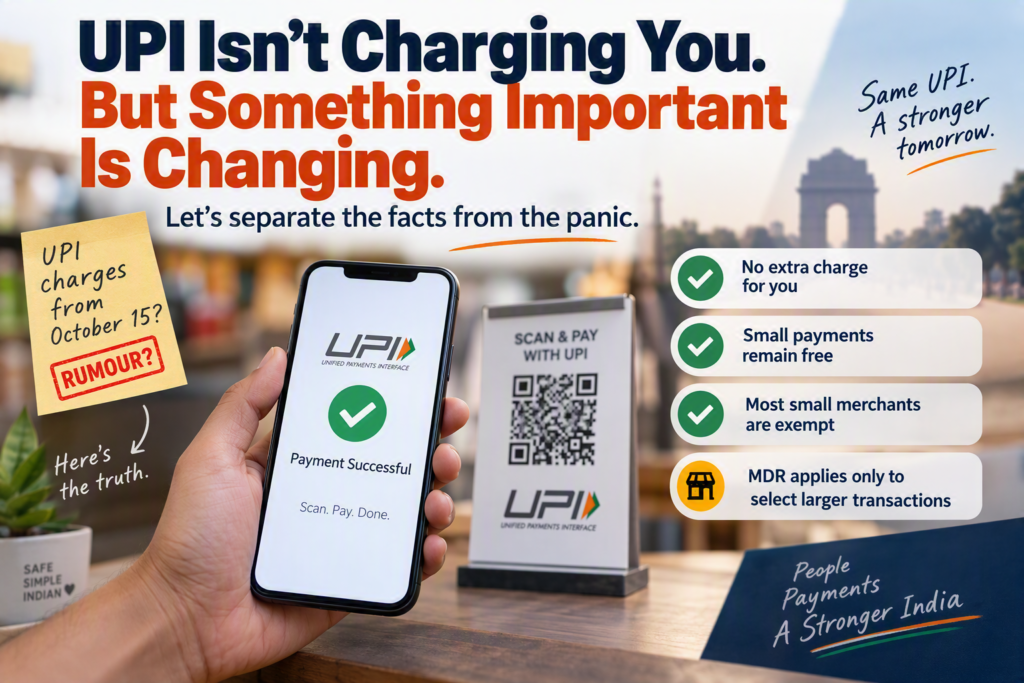
Your family WhatsApp group is buzzing.
“UPI won’t be free anymore.”
“From October 15, every payment will attract charges.”
“The government has quietly started charging people for digital payments.”
By the time you read the third forward, you’re wondering whether your next scan-and-pay transaction will cost more than the price on the bill.
The short answer?
No. UPI is not becoming a paid service for ordinary users.
But something important is changing behind the scenes, and understanding it matters because it could affect businesses, pricing, and the future of India’s digital payments ecosystem.
Let’s separate the facts from the panic.
In One Minute
✅ Consumers are not being charged for UPI payments.
✅ Sending money to friends and family remains free.
✅ Merchant payments up to ₹2,000 remain free.
✅ Most small merchants remain exempt.
✅ UPI apps cannot add a separate platform fee.
⚠️ Some eligible merchants will pay MDR on UPI transactions above ₹2,000.
⚠️ The longer-term impact on prices and merchant behavior remains uncertain.
So, Will I Be Charged for Using UPI?
No. Not a single rupee.
If you’re buying groceries, ordering food, filling fuel, shopping online, or paying at a local store, you still pay exactly what appears on the bill.
There is no new charge being added to your UPI payment.
The government’s position is that MDR is a merchant cost, not a consumer cost. Merchants are not supposed to recover it as a separate line item from customers, and UPI apps cannot simply introduce a “UPI convenience fee.”
For most users, the payment experience remains exactly the same:
Scan. Enter PIN. Done.
Then What Exactly Is Changing?
The change revolves around something called MDR, or Merchant Discount Rate.
Think of MDR as a handling fee paid by businesses for accepting a digital payment.
This isn’t new.
Merchants already pay MDR on many card transactions. Every time someone swipes a credit card, a small percentage of the transaction typically goes toward banks, payment networks, and payment providers.
What made UPI different was that merchants largely escaped this charge for years.
That is what is now changing.
Which UPI Payments Are Affected?
Far fewer than social media posts suggest.
Still Free
- Sending money to friends and family
- Everyday merchant payments up to ₹2,000
- Small merchants receiving up to ₹1 lakh per month through UPI QR payments
According to NPCI’s reported data, these categories account for the overwhelming majority of UPI transactions.
That means the tea stall near your office, your neighborhood vegetable vendor, and many kirana stores are likely to remain unaffected.
Where MDR Applies
For eligible merchant transactions above ₹2,000, MDR is set at 0.4%, subject to a maximum cap of ₹300 per transaction.
Certain sectors such as railways, telecom services, insurance, and fuel will reportedly operate under a fixed-fee structure instead.
What Does That Look Like in Real Life?
The merchant pays the fee, not the customer.
| Purchase | MDR Paid by Merchant |
|---|---|
| ₹3,000 shoes | ₹12 |
| ₹50,000 laptop | ₹200 |
| ₹1,20,000 sofa | ₹300 (maximum cap) |
Now compare that with a typical credit card transaction.
A merchant accepting a credit card often pays around 1.5% to 2.5%.
That means a ₹3,000 purchase could cost the merchant anywhere between ₹45 and ₹75.
Even after the proposed MDR framework, UPI remains significantly cheaper than many card-based payment options.
If UPI Was “Free,” Why Change Anything?
Because UPI was never truly free.
It was free for users.
But operating one of the world’s largest real-time payment systems costs money.
Every UPI transaction depends on:
- Banking infrastructure
- Payment gateways
- Servers and cloud systems
- Cybersecurity
- Fraud monitoring
- Settlement mechanisms
- Customer support operations
Someone has always paid those costs.
For years, part of that burden was offset through government incentives and support programs.
Now policymakers increasingly argue that India’s digital payments ecosystem has become mature enough to support itself without relying heavily on taxpayer-funded subsidies.
In simple terms:
The debate is shifting from “Who uses UPI?” to “Who should pay to keep UPI running?”
Who Took This Decision?
This is not simply an RBI decision.
Several institutions are involved.
The legal framework was changed to allow the government to determine which digital payment categories remain protected from charges.
The Finance Ministry subsequently notified protected categories, including UPI payments up to ₹2,000 and RuPay debit card transactions.
NPCI’s governing framework then introduced the MDR structure, rates, exemptions, and caps.
The RBI is expected to remain involved in consultations related to implementation and support mechanisms for smaller merchants.
So Where’s the Catch?
This is the part worth paying attention to.
The rules may say merchants cannot directly charge customers an MDR fee.
But economics rarely works that neatly.
If a business faces higher payment costs, it may look for ways to offset them.
That could mean:
- Slightly higher prices
- Preferential discounts for cash payments
- Refusing UPI for large transactions
- Encouraging alternative payment methods
Consumers may never see a line on a receipt labeled “UPI Fee.”
But they could still experience the effects indirectly.
Whether this happens on a meaningful scale is one of the biggest unanswered questions surrounding the new framework.
History offers a cautionary lesson.
When card-based MDR became common years ago, some merchants attempted to pass the cost to customers, leading many consumers back toward cash transactions.
Whether UPI follows a similar path remains to be seen.
Why Has the Move Become Political?
Not everyone agrees with the change.
Several opposition leaders have criticized the move, arguing that it could increase costs for businesses and eventually consumers.
Some have also alleged external influences behind the decision.
The government has rejected those allegations and says the objective is straightforward: create a sustainable revenue model for India’s domestic digital payments ecosystem while keeping the user experience affordable.
For now, the political debate continues alongside the policy debate.
Can the Rules Still Change?
Possibly.
A Public Interest Litigation (PIL) has reportedly been filed in the Supreme Court challenging aspects of the notification and the proposed fee framework.
The petition argues that the changes could adversely affect businesses and consumers.
At this stage, the matter is under judicial consideration.
The filing of a petition does not automatically suspend implementation, and the outcome remains uncertain.
As with any major regulatory change, future court rulings, government notifications, or NPCI circulars could alter the final picture.
What Should Consumers Do Right Now?
1. Keep Using UPI Normally
For most people, nothing changes.
Your direct cost remains zero.
2. Don’t Pay Any “UPI Convenience Fee”
If a merchant or app attempts to add a separate UPI charge to your bill, question it and report it to the relevant bank or payment platform if necessary.
3. Compare Prices for Large Purchases
For higher-value transactions, compare the final amount across payment methods before paying.
4. Ignore Viral Forwards
Trust updates from NPCI, RBI, the Finance Ministry, and PIB rather than screenshots and social media rumors.
The Bottom Line
Despite the headlines, UPI is not suddenly becoming a paid service for ordinary users.
For millions of Indians, daily transactions will continue exactly as before.
Scan.
Enter your PIN.
Pay.
The real change is happening behind the scenes.
India’s digital payments ecosystem has reached a scale where policymakers, banks, and payment companies are trying to answer a difficult question:
Who should pay for one of the largest digital payment networks in the world?
Starting October 15, the answer may no longer be “nobody.”
The bigger story isn’t whether consumers will pay a UPI fee today.
It’s whether those costs remain with businesses tomorrow, and how that affects prices, merchants, and India’s cashless future in the years ahead.
Sources: SCC Times, BusinessToday: MDR explained · BusinessToday: government’s response · MediaNama: PIL in Supreme Court · MediaNama: Who pays for UPI?